Writing
What I'm working on
One Substack, one book, one dissertation, and a long argument between Nietzsche and Zen that refuses to end.
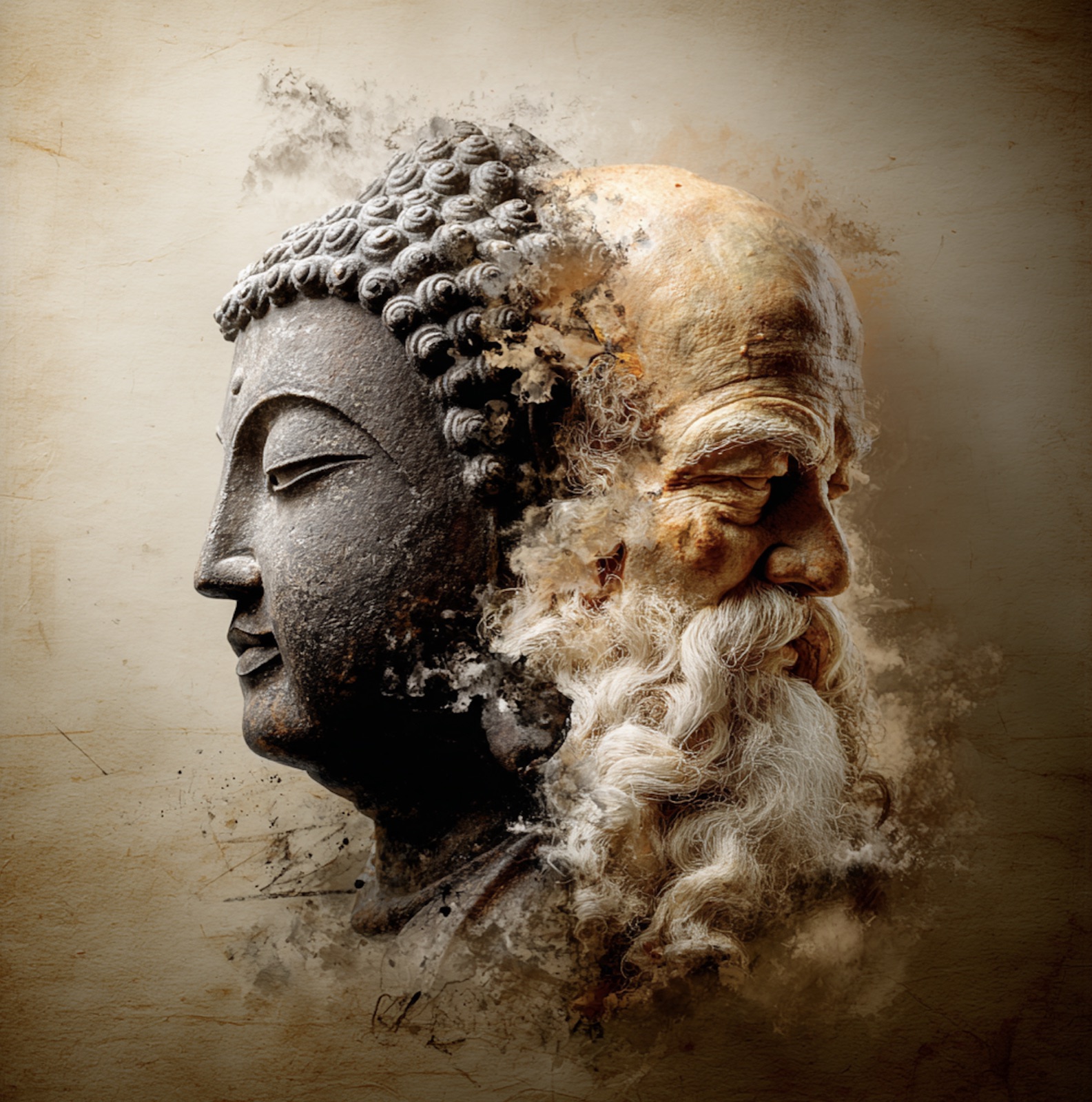
Fire Philosophy
Fire Philosophy is a Substack I co-write with Dale Wright, Professor Emeritus of Religious Studies at Occidental College. Dale spent a career on Zen Buddhism and Chinese Chan texts. I came at the same material sideways, through Nietzsche and American fiction.
What we publish is mostly the argument between those two positions. Nietzsche wants you to become who you are, which assumes there is a self in there worth becoming. Dogen says the self is the one thing you will never locate, and that looking is the practice. We have not settled it. The essays are what happens along the way, plus conversations we record when writing stops being enough.
You Must Change Your Life
A book in progress, subtitled Eight Hard Thinkers for an Age of Easy Answers. The title comes from Rilke, from the end of “Archaic Torso of Apollo,” where a broken statue with no head somehow looks at you and issues a command.
The premise: eight figures, each of whom answers Rilke’s demand differently. Socrates, Nietzsche, Heidegger, David Foster Wallace, Dogen and the Zen tradition, MacIntyre, Pynchon, and the poets. None of them offers a method. All of them insist the change has to cost you something.
The through-line is difficulty. We now have machines that will produce a competent paragraph on any subject, instantly, for free. That makes the struggle to produce your own paragraph look inefficient, and it is. It is also the only part that changes the person doing it. Knowledge turns out to be portable in a way wisdom is not. You cannot download a disposition. The book is an argument for declining the bargain and keeping the difficulty.
Buddhist Philosophy in the Work of David Foster Wallace
My 2013 dissertation at UT Austin, and still the piece of writing everything else grew out of. It is available in full through the university: Texas ScholarWorks.
The claim was that Wallace is doing Buddhist philosophy rather than referencing it. His fiction takes the doctrine of no-self seriously enough to be wrecked by it, and his treatment of addiction, boredom, and attention reads as a sustained working-out of craving in the Buddhist sense. The book people cite for the sentences turns out to be arguing something.
The Last Book Shelf
Not an essay, but it belongs here. I built The Last Book Shelf around a fact most reading apps hide from you: your shelf is finite because your life is. It caps how many books you can hold, runs a mortality counter, and tells you the truth about the ones you abandoned. Subtraction as a feature.
Where to start
If you want the philosophy, go to Fire Philosophy. If you want to know why a rhetoric professor spends his afternoons on options chains, the about page explains the connection, and the podcast is where the markets half lives.