How to Live in the Age of AI · week 1

Six problems of AI, illustrated

Technology now offers to take over all the parts of your day that were making you a person, especially the struggles and hard parts and imperfections that come with being a limited fleshy mortal being.

Each handoff looks harmless on its own: The God-device drafts your email, plans your week, remembers all the groceries, drives you to your destination and picks the next song without you asking.

At two in the morning it will even listen to you bitch and moan about all of it with an infinitely sympathetic “ear.”

But when you add up all those small, daily moments over a year, you end up with a life that runs faster and faster but feels more and more like it belongs to somebody else.

Our How to Live in the Age of AI seminar begins by examining six deals we're making with a careful eye to the costs.

0underneath all six · your time, mediated

You already live in mediated time

Week 7 · Zadie Smith“Some Notes on Mediated Time,” written new for Dead and Alive (2025), opens with a photograph. On WhatsApp, Smith and her friends are looking at a picture of themselves with a newborn baby.

The baby is fifteen now. In the photo the friends look almost childlike, though everyone in it was about thirty.

For years, Zadie Smith writes, time didn't seem to pass at all, and then it passed in a rush, which leaves her wondering whether farmers or monks are this amazed to turn forty.

So she asks how much of her life has reached her through a screen, and “how much mediation is too much?” She told Terry Gross that she really doesn't know.

Television, she says, was replacing ritual. What the phone has taken since, she calls “the capacity to be bored, alone, private, un-nudged.”

That is why this framing comes first: Each of the six AI handoffs that follow happens on the same screen that holds the photographs of us aging in a way that feels “out of time.”

Social media as a “way of being” got its claws into us before the current intelligent chatbot. The social feed taught a generation to encounter its own life at one remove, inside a digital frame by a company who profits from certain kinds of interactions and not others (e.g. more outrage, less patience), so that by the time a fancy program offered to write an essay or to keep us company, the habit(s) of letting a screen stand between us and our actual life had already been formed.

Zadie Smith is careful not to blame the internet for everything. She explicitly does not want to be known as the lady who hates it; so she began by writing about time and found that every medium she had lived through, from the television that raised her to the phone, had changed how time felt. We read her essay in week 7 beside Wallace's “This Is Water,” since mediation is the water here, the thing that surrounds everything else and is therefore the very hardest to see.
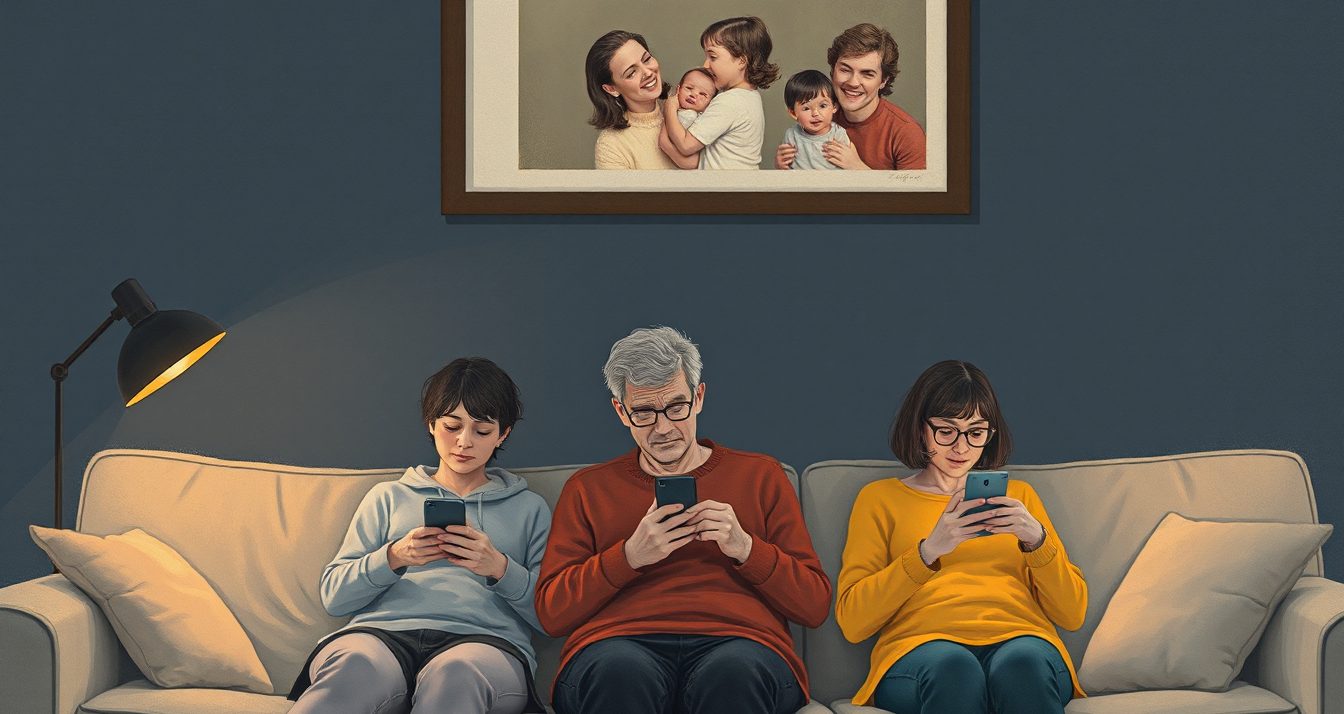
Three painted figures on a sofa at night, each lit by a phone, under a framed old photograph of young people holding a newborn

Zadie Smith, “Some Notes on Mediated Time,” in Dead and Alive, 2025 · her interview with Terry Gross, Fresh Air, 15 December 2025 · week 7

1of six · your thinking

You stop thinking the thoughts you hand over

A painted student at a desk, the lines of handwriting lifting off the page and drifting into a glowing phone

Ted Chiang points out that a piece of writing is thousands of small choices.

A program that makes most of them for you leaves very little that is yours.

In a 2025 MIT Media Lab study, students who wrote their essays with ChatGPT had trouble quoting a single line of what they had just handed in.

The study is small and has its critics, so don't take it on faith; ask whether it describes you.

Writing is where most of us find out what we think, so it makes sense that a tool that writes for us also does a good part of that finding out.

None of this is new. Heidegger saw it coming long before there was anything to type a prompt into:

After the machines for writing, adding, computing, and accounting, the production of a machine for thinking is only a question of “time.” Indeed, thinking has already become computing. And why should not this “thinking” have its machine? More and more is taken from the human being, even thinking (and meditation already long ago). The consequence of this process is that the human being knows less and less what to do with himself—and all the more must he surround himself with gadgets.

Martin Heidegger · Ponderings XII–XV, Black Notebooks 1939–1941

Chiang, “Why A.I. Isn't Going to Make Art,” 2024 · week 1 · Heidegger, Ponderings XII–XV: Black Notebooks 1939–1941

2of six · your company

You get company with no one in it

A painted figure lying awake in bed at night lit only by a phone, an empty chair beside the bed

A chatbot will listen to you at two in the morning and never once get bored of you, which is more than most of us can say for our friends.

Paul Bloom, a psychologist who once co-wrote a paper in praise of empathic AI, now worries about what such company takes away.

Loneliness hurts, but the misery and vulnerability of the pain is what keeps sending us back to each other's imperfections.

The person that never tires of you is also the same person who never needs anything from you. Our seminar bets on the older and more demanding kind of gathering: people in the same room who can get bored with you and who will tell you why you're wrong.

Bloom, “A.I. Is About to Solve Loneliness. That's a Problem,” 2025 · week 1

3of six · your time

You get faster, and the weeks still run out

Every tool, AI or not, that saves you an hour is pretty much guaranteed to replace it with more of the same, but more of the more and at faster and faster intervals, as anyone who has learned to answer email efficiently learned the hard way: “Oh, Krzysztof replies quickly and is reliable, so let's send him all our stuff. He'll take care of it.”

Oliver Burkeman did the arithmetic about our mortality: Eighty years is about four thousand weeks.

Here they are, a week to a square, eighty rows of fifty-two, filling in as you scroll.

Notice: there exist exactly zero systems for getting more done that also add a single week to your life.

The Week 1 exercise we do while reflecting on our own lives, Tim Urban's “Your Life in Weeks” chart, is where you fill in the weeks already spent. Maybe we begin to notice that efficiency only changes how full each square gets, and Burkeman's question turns our attention to what the remaining squares should feel like…

A painted figure at a laptop beneath a huge wall of small squares, many shaded in

Burkeman, Four Thousand Weeks, 2021 · week 1

4of six · your choices

Your choices are made for you and called recommendations

A painted figure in a wide meadow, one bright path curving away toward a glowing light on the horizon

The feed learns what you want and then nudges it.

It sells you things based on probability and its ability to guess what you already want. It helps you become the “you” you already are, but even harder.

Shoshana Zuboff calls the whole business surveillance capitalism, and its customers are the companies paying to know what you will do next year.

When we get to Kierkegaard, we read that from his perspective, the whole point as it were is the self that has to choose. A recommendation that is “right” most of the time is the hardest kind to notice, because it feels like your own taste but is really more like old tupperware.

Zuboff, “You Are Now Remotely Controlled,” 2020 · week 1, and her book in week 4

5of six · your imagination

You let AI do your imagining

A painted figure hesitating over a blank sheet of paper while a glowing tablet beside them already shows a finished picture

Ask for a story, a picture or a plan and one arrives in seconds, already imagined for you.

Zadie Smith defends the novelist's right to imagine her way into lives unlike her own.

That slow, risky imagining is the work the generators now offer to take off our hands, along with a good deal of our uncertainty, doubt, struggle, tension: all the ingredients necessary for creativity.

Zadie Smith's other essay we read is about the work of literature and fiction and why its mode of being is a kind of cure that helps everyone imagine lives unlike their own; or even their very own, but ten years down the road.

Zadie Smith, “Fascinated to Presume: In Defense of Fiction,” 2019 · week 1

6of six · your independence

You hand over your independence because everyone else seems to be doing just that, and you can't take it back alone

Ricard Solé, a complexity scientist in Barcelona and at the Santa Fe Institute, and eight colleagues model AI the way epidemiologists model a virus.

The habit spreads through colleagues, schools and workplaces.

Past a tipping point a whole population slides from using the tool to depending on it, a slide that takes far more to reverse than it took to start.

Their remedy? Find the people around you who keep thinking, reading and writing and arguing for themselves. Very much like the people in this seminar, if you think about the reason for enrolling that goes beyond downloading knowledge.

This is the problem of our socialization that makes the other five extremely hard to fix on your own. If dependence on AI passes from person to person, so does the habit of thinking for yourself. Let's be the remedy.

A painted open-plan office from above, most people bent toward glowing screens, a few at one table reading paper books under a lamp

Solé et al., “Large-Language Models as a Cognitive Virus,” 2026 · week 1

what the club does about it

Why read philosophers about this

Each of these losses is a capacity going slack, and a capacity can be regrown the way a muscle can, by people who make time for it. Attention, judgment, imagination, the nerve to choose, patience with something hard and the willingness to let another person tell you that you're wrong were the life's work of the philosophers and writers and poets the club reads, and many of them saw the trouble coming long ago.

A gardener in the Zhuangzi refused a labour-saving well-sweep more than two thousand years ago, for what it would do to his heart. Heidegger warned in 1955 that calculating thought would crowd out every other kind of thinking, and Wendell Berry refused to buy a computer in 1987 and explained why in Harper's.

A painted circle of about fifteen people in a lamplit room, reading paper books and writing in the margins

7:00 · the silencePhones face down and nobody talks for five minutes, which turns out to be long enough to notice what you dragged into the room with you.

7:15 · the marginsThirty minutes of reading the week's texts together in a shared doc, in silence, so by the end your own reading sits next to fourteen other people's.

7:45 · what looks backWhen we're all together we ask how the text argues, whether we agree or disagree, and then the hardest question of all: what it asks of your life and how you will thereafter change it.

Reading and arguing about these texts together, on a Monday night, with people who also showed up and can disagree with you, is practice in exactly the things the computer offers to do for you.

What technology takesWhat the club trains instead
Your attentionFifteen minutes alone in a quiet room with no phone, then an honest look at last week's screen-time numbers.
Your thinkingOne hour a week reading a challenging text, writing your own notes in the margins.
Your companyFifteen people who show up on Monday nights, and a conversation that can change your mind.
Your timeFive minutes of silence to open every session, and one exercise a week that slows something down.
Your choicesA practice you choose and keep for a month, and a short essay on what it did to you.
Your imaginationA monthly essay drafted by hand, where every sentence has to come from you.
Your independenceA room where thinking for yourself is the normal thing to do, since that habit passes from person to person the same way dependence does.